

Artículo de investigación- Transcriptomic analysis of bell pepper (Capsicum annuum L.) revealing key mechanisms in response to low temperature stress
Transcriptomic analysis of bell pepper (Capsicum annuum L.) revealing key mechanisms in response to low temperature stress - Molecular Biology Reports
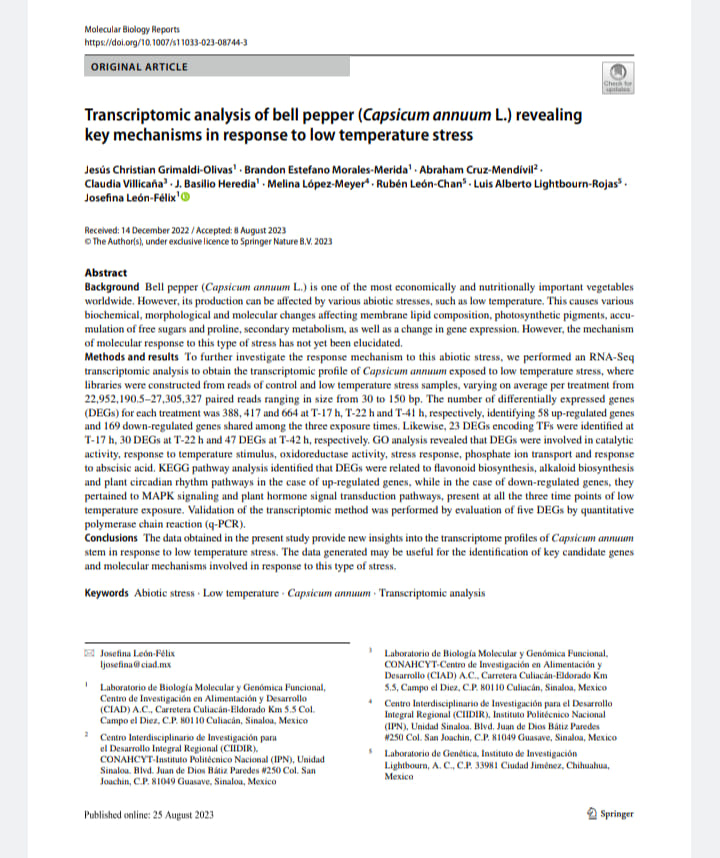
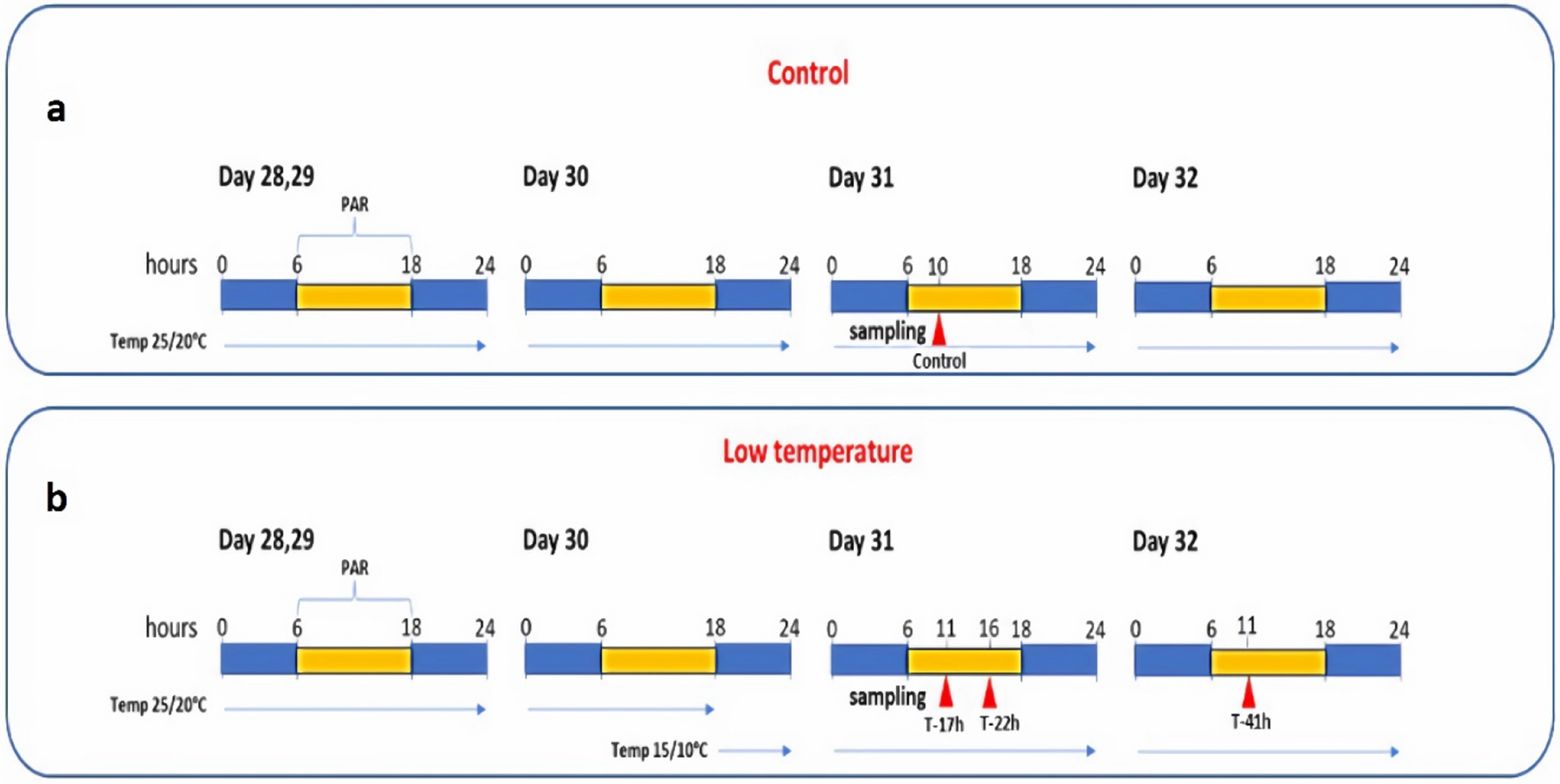
Background Bell pepper (Capsicum annuum L.) is one of the most economically and nutritionally important vegetables worldwide. However, its production can be affected by various abiotic stresses, such as low temperature. This causes various biochemical, morphological and molecular changes affecting membrane lipid composition, photosynthetic pigments, accumulation of free sugars and proline, secondary metabolism, as well as a change in gene expression. However, the mechanism of molecular response to this type of stress has not yet been elucidated. Methods and results To further investigate the response mechanism to this abiotic stress, we performed an RNA-Seq transcriptomic analysis to obtain the transcriptomic profile of Capsicum annuum exposed to low temperature stress, where libraries were constructed from reads of control and low temperature stress samples, varying on average per treatment from 22,952,190.5–27,305,327 paired reads ranging in size from 30 to 150 bp. The number of differentially expressed genes (DEGs) for each treatment was 388, 417 and 664 at T-17 h, T-22 h and T-41 h, respectively, identifying 58 up-regulated genes and 169 down-regulated genes shared among the three exposure times. Likewise, 23 DEGs encoding TFs were identified at T-17 h, 30 DEGs at T-22 h and 47 DEGs at T-42 h, respectively. GO analysis revealed that DEGs were involved in catalytic activity, response to temperature stimulus, oxidoreductase activity, stress response, phosphate ion transport and response to abscisic acid. KEGG pathway analysis identified that DEGs were related to flavonoid biosynthesis, alkaloid biosynthesis and plant circadian rhythm pathways in the case of up-regulated genes, while in the case of down-regulated genes, they pertained to MAPK signaling and plant hormone signal transduction pathways, present at all the three time points of low temperature exposure. Validation of the transcriptomic method was performed by evaluation of five DEGs by quantitative polymerase chain reaction (q-PCR). Conclusions The data obtained in the present study provide new insights into the transcriptome profiles of Capsicum annuum stem in response to low temperature stress. The data generated may be useful for the identification of key candidate genes and molecular mechanisms involved in response to this type of stress.
Transcriptomic analysis of bell pepper (Capsicum annuum L.) revealing key mechanisms in response to low temperature stress - Molecular Biology Reports
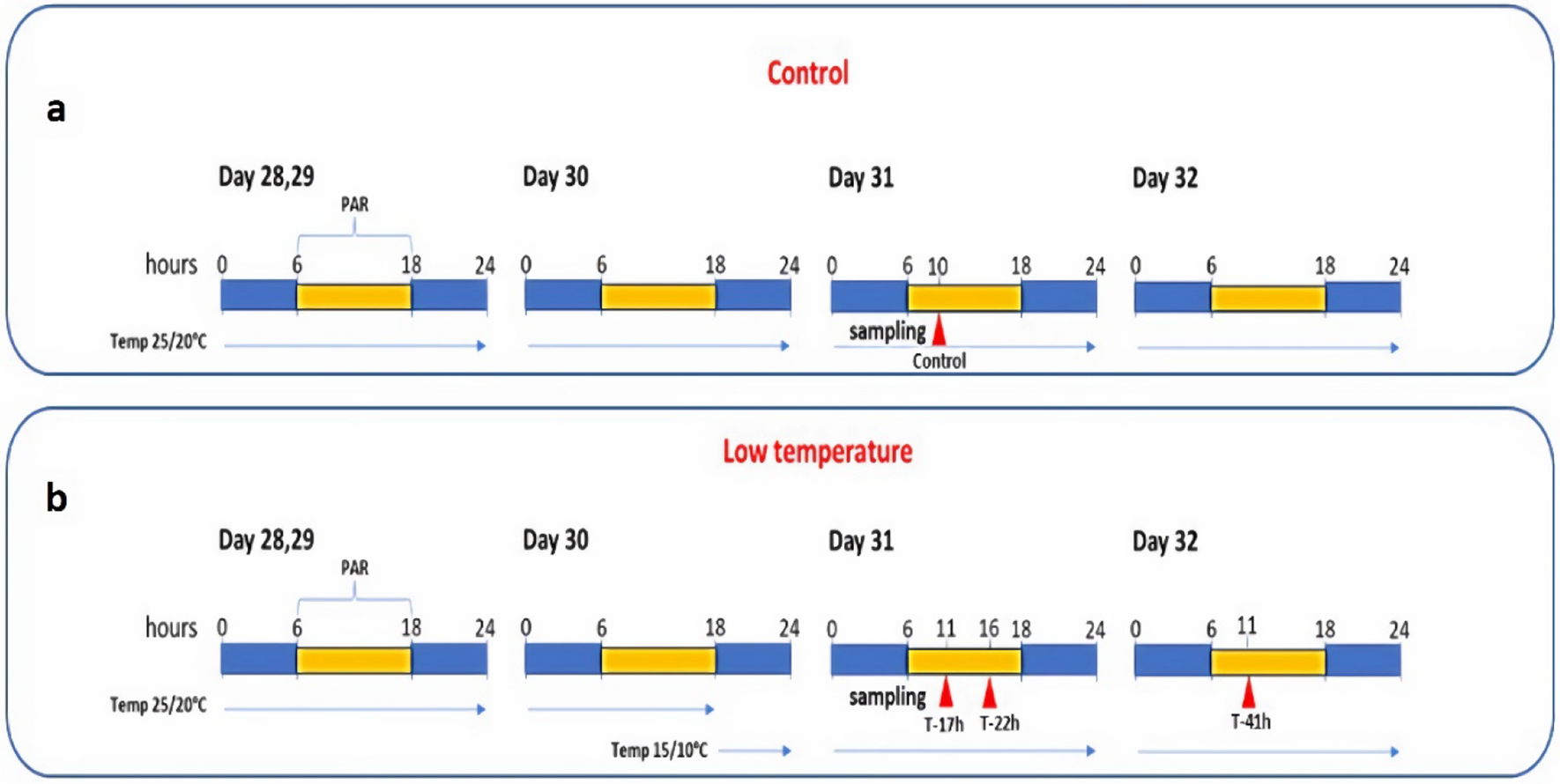
Background Bell pepper (Capsicum annuum L.) is one of the most economically and nutritionally important vegetables worldwide. However, its production can be affected by various abiotic stresses, such as low temperature. This causes various biochemical, morphological and molecular changes affecting membrane lipid composition, photosynthetic pigments, accumulation of free sugars and proline, secondary metabolism, as well as a change in gene expression. However, the mechanism of molecular response to this type of stress has not yet been elucidated. Methods and results To further investigate the response mechanism to this abiotic stress, we performed an RNA-Seq transcriptomic analysis to obtain the transcriptomic profile of Capsicum annuum exposed to low temperature stress, where libraries were constructed from reads of control and low temperature stress samples, varying on average per treatment from 22,952,190.5–27,305,327 paired reads ranging in size from 30 to 150 bp. The number of differentially expressed genes (DEGs) for each treatment was 388, 417 and 664 at T-17 h, T-22 h and T-41 h, respectively, identifying 58 up-regulated genes and 169 down-regulated genes shared among the three exposure times. Likewise, 23 DEGs encoding TFs were identified at T-17 h, 30 DEGs at T-22 h and 47 DEGs at T-42 h, respectively. GO analysis revealed that DEGs were involved in catalytic activity, response to temperature stimulus, oxidoreductase activity, stress response, phosphate ion transport and response to abscisic acid. KEGG pathway analysis identified that DEGs were related to flavonoid biosynthesis, alkaloid biosynthesis and plant circadian rhythm pathways in the case of up-regulated genes, while in the case of down-regulated genes, they pertained to MAPK signaling and plant hormone signal transduction pathways, present at all the three time points of low temperature exposure. Validation of the transcriptomic method was performed by evaluation of five DEGs by quantitative polymerase chain reaction (q-PCR). Conclusions The data obtained in the present study provide new insights into the transcriptome profiles of Capsicum annuum stem in response to low temperature stress. The data generated may be useful for the identification of key candidate genes and molecular mechanisms involved in response to this type of stress.
https://link.springer.com/article/10.1007/s11033-023-08744-3
Comentarios